

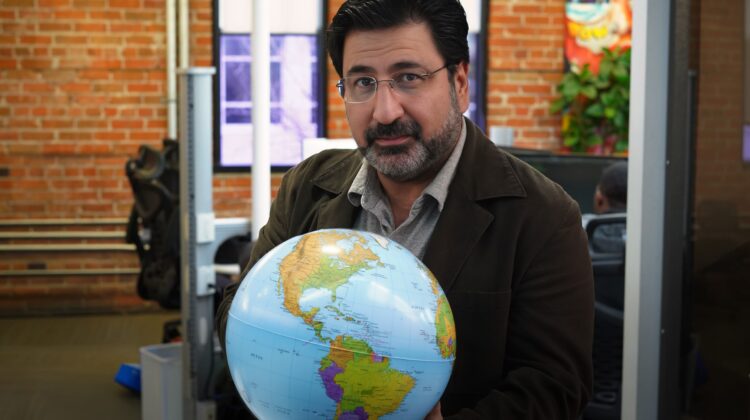
Calgary tech researchers are earning national recognition for advancing the next generation of digital mapping — technology with the potential to reshape how industries understand the world above, on, and beneath the Earth’s surface.
University of Calgary computer science professor Dr. Faramarz Samavati has received the Mitacs Innovation Award for Outstanding Research Leadership, honouring more than two decades of pioneering work developing a made-in-Canada 3D digital earth system. The award, presented by Mitacs, recognizes researchers who translate cutting-edge academic work into real-world innovation through strong industry collaboration.
Samavati’s long-running Mitacs-supported research has led to the creation of the Discrete Global Grid System (DGGS) — a fundamentally new way to represent the Earth that avoids the distortions of traditional flat-map GIS tools like Google Maps. Developed in partnership with Calgary software studio Vivid Theory, the technology is now being commercialized by Calgary startup BigGeo, where Samavati serves as lead scientist.
What began as a small DGGS prototype eventually grew into a multi-year R&D effort backed by more than $1 million in Mitacs funding, enabling the team to build a system capable of ultra-fast, high-resolution geospatial search. “Once our team demonstrated its ability to tackle complex challenges, the initiative quickly scaled,” Samavati said.
Because DGGS models the Earth as a curved surface rather than a flat projection, it delivers more consistent and distortion-free processing — a major advantage for sectors relying on precise geospatial intelligence. Early applications now being tested span agriculture, climate resilience, wildfire simulation, drone path planning, and complex industrial routing.
“Whether you’re searching for a home online, planning a pipeline route, or optimizing an Uber trip, you rely on geospatial queries — and our platform does it faster and more consistently,” Samavati said, adding that he hopes the technology achieves Google-Maps-level ubiquity.
The system’s “digital quilt” divides the planet into uniform, multiresolution cells capable of integrating data from satellites, drones, smartphones, and sensors — even in remote regions like Canada’s Arctic. It also supports data sovereignty, ensuring that Canadian datasets remain stored and managed within national infrastructure.
Samavati is one of 11 Mitacs award winners nationally, selected from thousands of researchers across the country. Mitacs CEO Dr. Stephen Lucas praised this year’s cohort for demonstrating what’s possible when Canada invests in innovation talent. “At a time when we need to build a stronger and more resilient economy, these eleven innovators and organizations show the power of ideas translated into impact,” he said.
Leave a Reply