


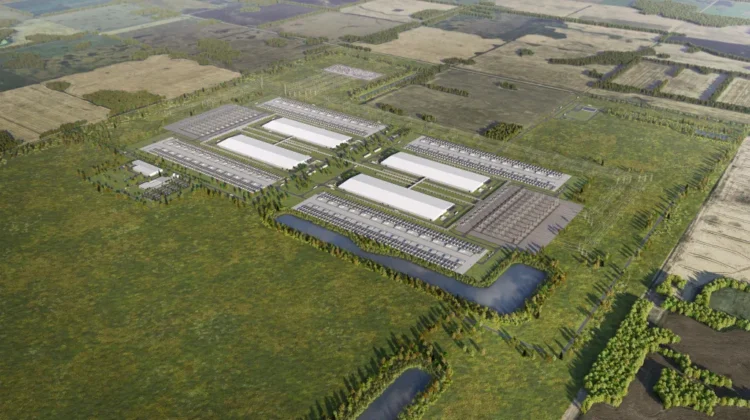
Meta is making one of Alberta’s biggest-ever technology infrastructure bets.
The company has officially unveiled plans for the Meta Sturgeon Data Centre, a $13 billion-plus project in Sturgeon County, northeast of Edmonton, that will become Meta’s first data centre in Canada.
The project represents a major win for Alberta’s effort to position itself as a destination for artificial intelligence infrastructure, advanced computing, and large-scale digital investment.
Meta says the Sturgeon Data Centre will form part of the global infrastructure behind its technologies and programs, which are used by more than 3.5 billion people around the world. The company expects approximately 3,000 skilled trade workers to be onsite at peak construction, with the completed facility supporting roughly 300 operational jobs.
Frost Collective, a joint venture between Clark Builders and PCL Construction, is the general contractor for the Sturgeon Data Centre. Meta says it is making a concerted effort to source labour and materials locally where possible.
The company is also investing approximately $60 million in public infrastructure projects in Sturgeon County, including roads and water infrastructure. Meta says it is making additional network infrastructure investments to help the region accommodate future large-scale developments.
The project is closely tied to Alberta’s energy advantage.
Pembina Pipeline, Morgan Stanley Infrastructure Partners, and Kineticor Asset Management are partners in the Greenlight Electricity Centre, a dedicated, behind-the-meter power-generation project that will provide the large-scale electricity needed to power Meta’s data centre. Pembina says Greenlight follows a recent positive final investment decision and reflects Alberta’s ability to attract major projects by combining energy resources, skilled labour, and a supportive business environment.
Greenlight is a 932-megawatt gas-fired combined-cycle power-generation facility in Sturgeon County within Alberta’s Industrial Heartland. The project is expected to enter service in the second half of 2030 and supply electricity to the data centre under a long-term agreement.
For Alberta, the model is important: large AI data centres are being expected to bring their own power and pay for the infrastructure needed to support their operations. Sturgeon County says the Meta project will combine grid-connected electricity with new on-site natural-gas generation, reducing pressure on the provincial grid while supporting one of the largest private-sector investments in Canadian history.
Meta says it has been working with Greenlight Limited Partnership, Altalink, Capital Power, and the Alberta Electric System Operator to plan for its energy needs years in advance. The company says it will pay the full cost of the energy used by the data centre so consumers are not negatively affected.
Meta also says it is working to identify and contract new clean energy projects in the region to match the data centre’s electricity use, consistent with its practice of matching annual electricity consumption with 100 per cent clean and renewable energy.
Water use is another focus of the project. Meta says the Sturgeon facility will use a closed-loop system that recirculates a water mixture through its data halls to absorb and transfer heat from high-density computing hardware. That heat will then be removed through dry cooling, which Meta says requires no operational water use.
The company says water will still be needed for construction, facilities use, and fire sprinkler systems, while the site will also incorporate native vegetation, rainwater capture, and water-saving fixtures.
For Alberta, the announcement is more than a single data centre. It is a signal that the province’s combination of energy, land, construction capacity, and industrial infrastructure can attract global hyperscale technology investment.
And for Sturgeon County, Meta’s arrival could help turn the region into one of Canada’s most important new nodes in the AI infrastructure economy.
Leave a Reply