


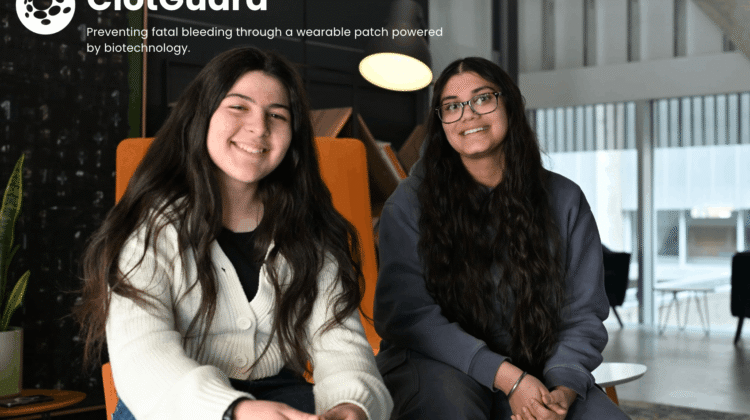
Two Calgary teenagers are taking aim at one of the most urgent challenges in emergency medicine: uncontrolled bleeding.
ClotGuard, a medtech startup founded by Sophia Dhami and Isavella Tsoulias, is developing a wearable patch designed to detect active bleeding in real time and deliver targeted clotting support directly at the site of injury. The goal is simple but ambitious—reduce the time between injury and treatment in situations where seconds can mean the difference between life and death.
The idea originated through The Knowledge Society’s (TKS) Moonshot Challenge, where the founders set out to address a problem that remains one of the leading causes of preventable death in trauma. What began as a concept is now moving toward a working prototype.
ClotGuard’s approach combines embedded biosensors with a microneedle-based delivery system. The patch is designed to detect key biomarkers associated with bleeding and respond by deploying clotting agents directly to the wound. The broader vision includes advanced capabilities such as targeted delivery mechanisms using biomaterials and precision treatment systems.
Despite being early-stage, the Calgary-based team is already gaining traction.
ClotGuard recently received $5,000 in non-dilutive funding from UCeed Investment Funds at the University of Calgary, providing early validation and resources to accelerate development. The startup is also collaborating with Microsoft as it builds out its external hardware prototype, sourcing key components for its capsule and microneedle-based system.
The company’s ambitions extend well beyond a single device. ClotGuard is positioned at the intersection of wearable technology, biotechnology, and emergency response—an area seeing growing interest as healthcare systems look for faster, more decentralized interventions.
For Dhami and Tsoulias, the journey is also about contributing to Calgary’s broader innovation ecosystem. As founders aged just 15 and 16, they represent a new wave of entrepreneurs emerging earlier and tackling increasingly complex, science-driven problems from the outset.
Their progress underscores a shift Calgary.tech has been tracking closely: high-impact ideas are no longer confined to experienced founders or well-funded labs. Increasingly, they are coming from students willing to take on global challenges with bold, technically ambitious solutions.
As ClotGuard continues to move from concept to prototype, it stands as both a promising approach to trauma care and a signal of the next generation of builders taking shape in Calgary.
Leave a Reply