


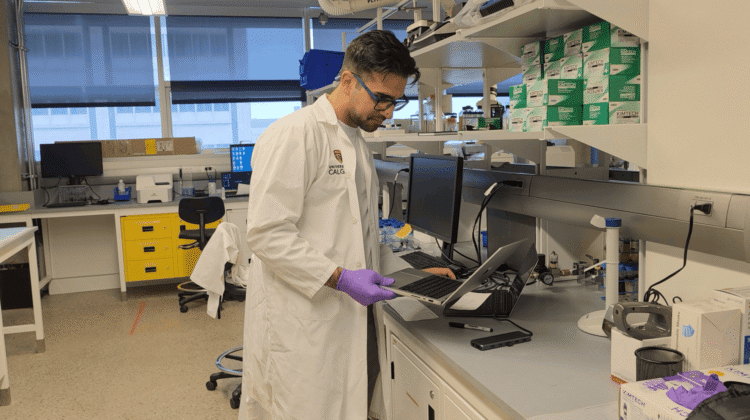
A technological breakthrough from a Calgary-based researcher could change the game for carbon nanofibre producers in Canada.
Carbon nanofibres are in growing demand across various Canadian industries such battery, concrete, and plastics manufacturing.
But producing them is historically a slow and energy-intensive process.
Amirhossein Foroughi says that, thanks to his work, producers can now forecast product quality while a production run is still underway, instead of waiting for post-run lab results, which can substantially cut down on labour and energy.
Foroughi, a Master of Science in Electrical Engineering graduate from the University of Calgary, has been recognized for his work through a 2026 Mitacs Innovation Award for “Outstanding Innovator.”
“Innovation matters most when it pays off for people,” believes Mitacs CEO Dr. Stephen Lucas. “That is the return on innovation our award winners are delivering.”
Working with Calgary cleantech startup Carbonova, Foroughi developed a machine learning system that tracks reactor conditions in real time and predicts the quality of carbon nanofibres as they’re being processed.
The technology then automatically adjusts conditions as necessary, eliminating the need for human operators to continuously oversee complex chemical reactions.
“Because the carbon nanofibre manufacturing process is relatively new, there were no public datasets available,” Foroughi recalls. “Since every production run takes a lot of time and money, there was very little data to learn from.”
Foroughi “used AI to create realistic ‘practice’ data from those few real runs.”
“That data trained a model to predict the quality of the material before it’s tested at the end of the run,” he says. “The result is faster, lower-cost decisions in the lab, which enables production of high-quality material to be sped up at scale.”
The technology was developed specifically for Carbonova’s carbon nanofibre production, but moving forward has the potential to be applied across the broader material sciences industry, according to Foroughi.
“Any company working with complex chemical manufacturing processes could adapt the model using their own production data,” the researcher suggests.
Foroughi is one of 10 Mitacs award winners nationally, nominated from a pool of thousands of innovators.
Established in B.C. in 1999, Mitacs co-funds innovation partnerships that boost Canada’s businesses and researchers to help commercialize innovation sooner.

Leave a Reply