


As holiday impaired-driving cases rise, a Calgary student’s AI project offers a glimpse of what youth innovation can deliver.
Calgary student Aryan Sharma is earning international recognition for tackling one of Alberta’s most persistent public-safety challenges: impaired driving. The 15-year-old was recently named Canada’s sole honouree at Intel’s Global AI Festival, a worldwide program celebrating young innovators using artificial intelligence for real-world social impact.
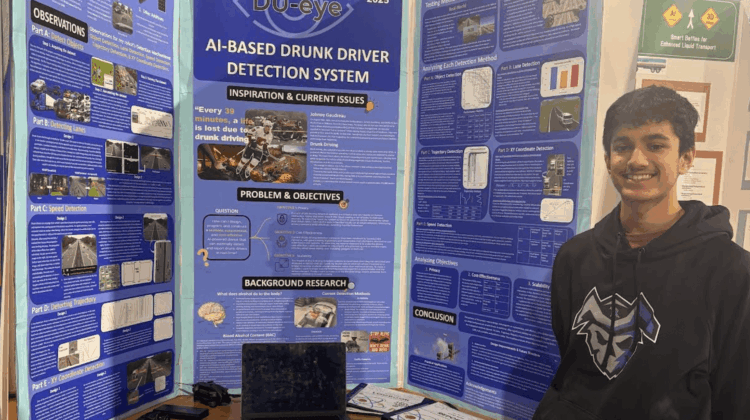
Sharma’s award-winning project, DU-Eye, is an AI-powered system designed to detect signs of impaired driving in real time. He began building the prototype at age 14 and has spent the past two years refining the device’s ability to read behavioural cues, environmental movement, and vehicle dynamics.
The work comes at a critical moment. During last year’s holiday season, Calgary police laid nearly 1,700 impaired-driving charges, including more than 1,200 cases in which drivers refused or failed roadside alcohol or drug tests.
For Sharma, the issue is painfully personal. A lifelong hockey fan, he was devastated by the 2024 drunk-driving accident that killed former Calgary Flames star Johnny Gaudreau and his brother, Matthew. The tragedy sparked a question he couldn’t shake: Could technology have prevented this? That inquiry eventually evolved into DU-Eye.
Sharma has competed in science fairs since Grade 7, building projects at the intersection of electrical engineering, software development, mechanics, and applied AI. His early achievements—and now global recognition—highlight the rising depth of STEM talent emerging from Calgary schools.
“Young innovators remind us of the extraordinary potential that exists when curiosity meets compassion,” said Asma Aziz, General Manager at Intel Canada. “Intel is committed to supporting and empowering the next generation of brilliant minds, and this type of work shows how AI can be a powerful force for social good.”
While DU-Eye remains in early testing, Sharma hopes to explore pilot opportunities with municipal partners to assess the system’s feasibility for real-world deployment. For a city working to reduce impaired driving, his work offers a reminder that innovation sometimes starts far earlier—and closer to home—than expected.
Leave a Reply